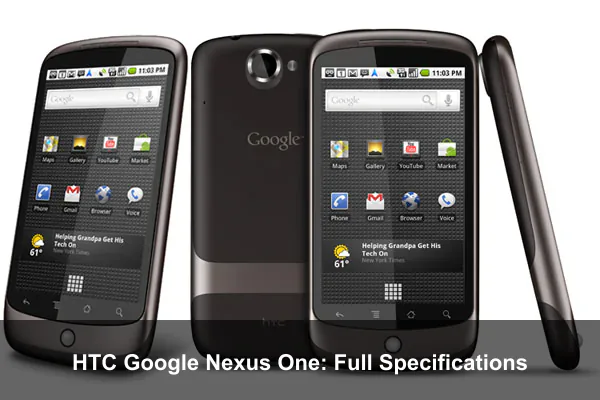
The HTC Google Nexus One is one of Android’s landmark devices, announced and released in January 2010 with a compact body, AMOLED screen, and the iconic trackball navigation style.
Instead of repeating the raw spec sheet, this guide looks at its practical value today: what still works, what feels outdated, and where it fits in a modern buyer comparison.
Full Specifications
Network
| Technology |
GSM / HSPA |
| 2G bands |
GSM 850 / 900 / 1800 / 1900 |
| 3G bands |
HSDPA 900 / 1700 / 2100 |
|
HSDPA 850 / 1900 / 2100 – for AT&T, Rogers Wireless |
| Speed |
HSPA 7.2/2 Mbps |
Launch
| Announced |
2010, January. Released 2010, January |
| Status |
Discontinued |
Body
| Dimensions |
119 x 59.8 x 11.5 mm (4.69 x 2.35 x 0.45 in) |
| Weight |
130 g (4.59 oz) |
| SIM |
Mini-SIM |
|
Trackball |
Display
| Type |
AMOLED |
| Size |
3.7 inches, 39.0 cm2 (~54.8% screen-to-body ratio) |
| Resolution |
480 x 800 pixels, 5:3 ratio (~252 ppi density) |
Platform
| OS |
Android 2.1 (Eclair), upgradable to 2.3.6 (Gingerbread) |
| Chipset |
Qualcomm QSD8250 Snapdragon S1 |
| CPU |
1.0 GHz Scorpion |
| GPU |
Adreno 200 |
Memory
| Card slot |
microSDHC (dedicated slot), 4 GB included |
| Internal |
512MB RAM, 512MB |
Main Camera
| Single |
5 MP, AF |
| Features |
LED flash |
| Video |
480p@24fps |
Selfie camera
Sound
| Loudspeaker |
Yes |
| 3.5mm jack |
Yes |
Comms
| WLAN |
Wi-Fi 802.11 a/b/g |
| Bluetooth |
2.1, A2DP |
| Positioning |
GPS, A-GPS |
| Radio |
Factory locked by default, can be enabled |
| USB |
microUSB 2.0 |
Features
| Sensors |
Accelerometer, proximity, compass |
| Browser |
HTML |
|
Dedicated search key MP3/eAAC+/WAV player MP4/H.264 player Voice memo Predictive text input |
Battery
| Type |
Removable Li-Ion 1400 mAh battery |
| Stand-by |
Up to 290 h (2G) / Up to 250 h (3G) |
| Talk time |
Up to 10 hours (2G) / Up to 7 hours (3G) |
| Music play |
Up to 20 hours |
Misc
| Colors |
Brown (teflon coating) |
| SAR |
0.37 W/kg (head) 0.74 W/kg (body) |
| Price |
About 120 EUR |
Our Tests
| Camera |
Photo |
| Loudspeaker |
Voice 69dB / Noise 66dB / Ring 79dB |
| Audio quality |
Noise -86.1dB / Crosstalk -85.2dB |
Price and Availability
The HTC Google Nexus One offers a compelling combination of features and performance. While the base price is around €120, the actual cost may vary depending on your location and retailer. Below, you’ll find the approximate price of the HTC Google Nexus One converted into various currencies. Please note that these are estimates based on recent exchange rates as of March 26, 2026 and may not reflect the exact price you’ll find at a retailer.
- United States: $139
- Japan: ¥22,113
- United Kingdom: £104
- Australia: A$200
- Canada: C$192
- Taiwan: NT$4,436
- Denmark: kr896
- Saudi Arabia: ﷼521
- South Korea: ₩208,510
- Germany: €120
- Brazil: R$727
- Vietnam: ₫3.629.300
- Kenya: KSh 18,044
- India: ₹13,053
- Indonesia: Rp 2.343.941
- Nigeria: ₦191,388
- Pakistan: ₨38,797
- Philippines: ₱8,349
- Bangladesh: ৳১৭,০৪১
Value in 2026: More Classic Than Mainstream
With a listed price of about 120 EUR, the Nexus One is better viewed as a collector or enthusiast purchase than a primary phone. Its value comes from historical significance and early Google-Android identity, not modern performance-per-dollar.
Design and Build
The 119 x 59.8 x 11.5 mm frame and 130 g weight make it very compact by current standards. The Mini-SIM format and physical trackball give it a distinctly old-school interaction style, while the brown teflon finish helps it stand out from today’s glass-slab designs.
Display Quality
The 3.7-inch AMOLED panel delivers solid contrast for its era, and the 480 x 800 resolution remains readable on a small screen size. Compared with current devices, the panel is far smaller and less immersive, but still pleasant for basic tasks and retro use.
Performance Expectations
The Snapdragon S1, 1.0 GHz Scorpion CPU, Adreno 200 GPU, and 512MB RAM define a light-use profile. Core functions like calls, messaging, and simple media playback are manageable, but modern multitasking and heavy apps are outside its realistic comfort zone.
Camera Performance
The single 5 MP autofocus rear camera with LED flash can produce usable daylight shots, and video tops out at 480p at 24fps. There is no selfie camera, so this is strictly a basic imaging setup by current standards.
Battery and Endurance
The removable 1400 mAh battery is a practical advantage for long-term ownership because cells can be replaced. Official endurance figures are respectable for its class, but real-world life now will depend heavily on battery condition and network usage.
Software and App Compatibility
Android 2.1 upgradable to 2.3.6 is historically important but heavily limited for modern app ecosystems. Expect major compatibility and security constraints, making this device better suited to legacy Android exploration than daily app-driven workflows.
Connectivity and Network Reality
Connectivity includes GSM/HSPA, Wi-Fi a/b/g, Bluetooth 2.1, GPS/A-GPS, microUSB 2.0, and a 3.5 mm headphone jack. In practical terms, the lack of newer cellular standards means usability depends on whether your local carriers still support compatible 2G/3G service bands.
Who Should Buy HTC Google Nexus One
This phone best fits collectors, Android history fans, and users who want a secondary device for nostalgia or light offline tasks. If you need reliable modern app support and long-term network compatibility, a newer budget smartphone is the better buy.
Conclusion
The HTC Google Nexus One remains a meaningful piece of smartphone history with compact hardware and classic Android character, but it is now a niche choice. Buy it for collection value and retro experience, not as your main everyday phone.